
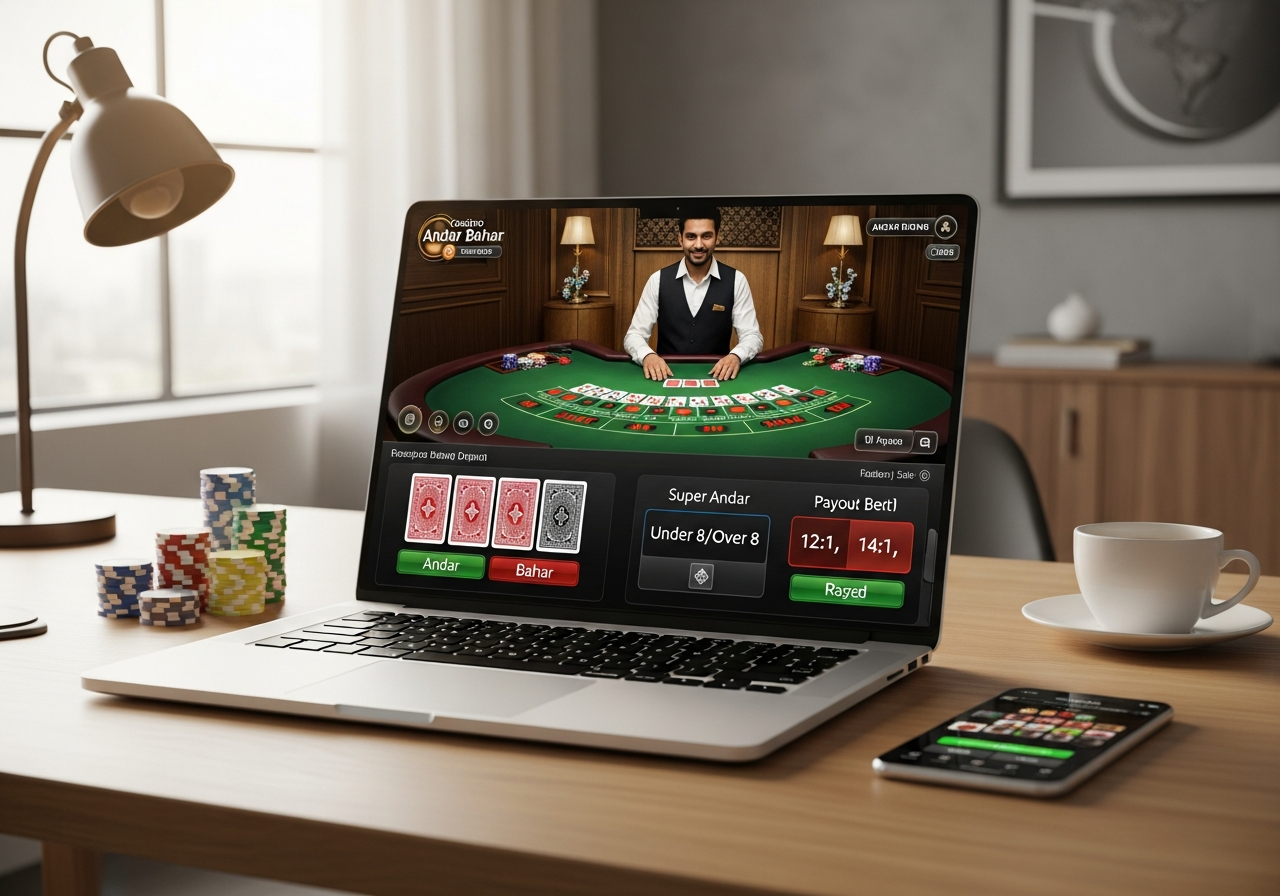
Andar Bahar has evolved from a traditional Indian card game into one of the most popular offerings in online casinos, particularly in live dealer environments. Players around the world, especially in India, are drawn to its simplicity and fast-paced nature. However, the introduction of side bets has transformed the game from a straightforward two-outcome gamble into a multi-layered betting experience with varying risk profiles and payouts.
This guide is designed to help you understand how to play Andar Bahar with side bets strategically. We’ll walk through the core rules quickly, then dive deep into each major side bet type—explaining the conditions to win, typical payouts, volatility levels, and practical strategies for real-money online play. Our emphasis throughout is on responsible gambling, intelligent bankroll management, and making informed decisions rather than chasing unrealistic returns.
Understanding The Core Andar Bahar Game
Andar Bahar is played with a single deck of 52 cards. The dealer begins by placing one card face-up in the center of the table—this is called the Joker, or house card. Players then place bets on either Andar (which means “inside” in Hindi) or Bahar (meaning “outside”). The dealer then alternates placing cards: one to the Andar side, one to the Bahar side, continuing until a card matching the rank of the Joker appears. Whichever side receives the matching card wins the round.
The mathematical structure of Andar Bahar creates a natural imbalance. Because Andar receives the first card after the Joker, it has a statistically higher chance of winning—approximately 51.5% versus 48.5% for Bahar. To compensate for this advantage, casinos typically offer slightly lower payouts on Andar (often around 0.9:1 or similar) while offering equal or slightly better payouts on Bahar (often 1:1 or evens). This payout adjustment keeps the overall house edge in check for the base game, typically within 2–4% depending on the specific table structure.
Understanding this foundational imbalance is crucial before considering side bets. Side bets exploit even rarer outcomes and carry materially higher house edges, which is why comparing them against the base game’s expected value is essential.
Card Flow, Bets And Payout Structure
A complete round unfolds as follows: the deck is shuffled, the Joker is dealt and revealed, and players place their main bets on Andar or Bahar. The dealer then begins alternating card placement. If you bet on Andar and a card matching the Joker’s rank lands on the Andar side, your bet wins at the designated payout. If Bahar receives the matching card first, the Andar bet loses.
Payout structures vary by casino and table variant. A typical live table might offer Andar at 0.9:1 (meaning a ₹100 bet returns ₹90 profit) and Bahar at 1:1 (meaning a ₹100 bet returns ₹100 profit). Some premium tables or promotional variants adjust these slightly. Always check the payout panel displayed on your screen before placing stakes, as small differences in payouts significantly affect your long-term expected value.
Side bets are placed simultaneously with or sometimes immediately after the main bet, depending on the table’s interface. Once the main bet and any side bets are locked in, the dealing sequence begins and cannot be altered. This is why understanding each side bet’s trigger condition before placing stakes is critical.
Probability, House Edge And RTP Basics
The concept of house edge is essential to grasp before adding side bets to your play. House edge is the mathematical advantage the casino holds over the player over time. For the base Andar Bahar game, the house edge is typically 2–4%, meaning that over thousands of hands, the casino expects to retain that percentage of total wagered money. Conversely, the Return to Player (RTP) is the inverse—if house edge is 3%, RTP is 97%.
Side bets almost always have higher house edges. A side bet that appears to offer a 10:1 payout might come with a 15–25% house edge, meaning the casino retains far more per wagered rupee. This does not mean side bets should never be played, but it means they should be treated as entertainment expenses with capped exposure, not as primary income sources.
For example, a Super Andar side bet (which wins only if the first card dealt to Andar matches the Joker’s rank) occurs roughly 1 in 51 times, yet payouts might range from 12:1 to 16:1. While the payout looks generous, the rarity of the outcome and the structure of deck composition mean the expected value for the side bet is significantly lower than the base game.
Types Of Andar Bahar Available In Indian Online Casinos
Indian online casinos offer both RNG (Random Number Generator) virtual Andar Bahar and live-dealer versions. RNG tables are faster, have lower minimum bets, and are suitable for casual play. Live dealer tables provide an immersive experience with real dealing and social interaction, but typically have higher minimums and slower hand speeds. Both formats support side bets, though the specific side bets offered and their exact rules can vary by operator.
| Variant | Provider / Environment | Side Bets Offered | Payout Style | Target Player |
|---|---|---|---|---|
| Standard RNG Andar Bahar | Virtual / Software-based | Super Andar, Super Bahar, Under/Over 8 | Andar 0.9:1, Bahar 1:1 | Speed-focused, low-stake casual players |
| Premium Live Dealer | Live streaming studios | Super Andar, Super Bahar, First 3 Cards, color/suit Joker bets, card count ranges | Variable (Andar 0.85–1:1, Bahar 0.95–1.1:1) | Immersive experience seekers, mid-stakes players |
| High-Roller Live Tables | Dedicated high-limit streams | Extended side bet menu (includes specific Joker card bets, complex ranges) | Premium payouts on main, enhanced side bet odds | Professional and high-bankroll players |
| Promotional / Tournament Variants | Event-based or limited-time | Often 8–12 unique side bets, sometimes including jackpot or lucky draws | Inflated payouts for tournament appeal | Bonus hunters, promotional players |
| Mobile-Optimized RNG | App-based or responsive web | Core side bets (Super, Under/Over) | Standard adjusted payouts | Mobile-first Indian players |
Live Dealer Vs RNG Andar Bahar Experiences
Live dealer Andar Bahar offers authenticity and pace that appeals to players seeking a casino atmosphere without leaving home. A live table typically processes one hand every 30–60 seconds, with professional dealers managing the cards and a UI overlaying betting panels and side bet options. The live interface often highlights available side bets prominently, which can encourage more frequent side-bet play.
RNG Andar Bahar delivers results instantly—a new hand can begin every 5–15 seconds depending on the platform. The lack of dealing time and human interaction suits players who prioritize quick sessions or want to test strategies at lower stakes. Side bet availability on RNG tables is identical in rule structure but often appears as pop-up buttons or checkboxes rather than the visual prominence seen in live setups.
One key difference: live tables are subject to table limits (often ₹500 to ₹5,000 minimum, ₹100,000+ maximum per hand), while RNG tables might have much lower minimums (₹10 or ₹25). Conversely, some premium live tables have no upper limit. Always check the specific table’s limit panel before joining, as this affects side bet sizing options.
Core Side Bets You’ll See On Indian Andar Bahar Tables
When you sit at an Andar Bahar table, the betting panel typically displays several optional wagers beyond the main Andar/Bahar bet. Here is a practical one-glance overview of the most common side bets:
- Super Andar – Wins if the first card dealt to Andar matches the Joker’s rank. Payout typically ranges 12:1 to 16:1. Risk level: High (rare occurrence, high volatility).
- Super Bahar – Wins if the first card dealt to Bahar matches the Joker’s rank. Payout typically ranges 10:1 to 14:1. Risk level: High (rarer than Super Andar due to Bahar’s statistical disadvantage, but payouts may be slightly lower).
- First 3 Cards – The Joker plus the first card on Andar and the first card on Bahar form a three-card hand (evaluated as a straight, flush, pair, trips, or other combinations depending on the table). Win if the hand qualifies. Payout ranges 25:1 to 100:1+ depending on hand strength. Risk level: High (very rare qualifying hands, but potential for large payouts).
- Under 8 / Over 8 – The Joker’s rank determines the outcome. If the Joker is ranked 2–7, “Under 8” wins; if 8–Ace, “Over 8” wins. Payouts typically range 1.8:1 to 2.2:1. Risk level: Medium (roughly 50/50 split, but payout reduction accounts for house edge).
- Specific Joker Card / Rank Bet – Player selects an exact rank (2 through Ace) that they predict the Joker will be. Win if the Joker matches. Payout ranges 4:1 to 5:1 per rank. Risk level: High (roughly 1 in 13 chance, but payouts do not fully offset the probability).
- Color / Suit of Joker – Player bets the Joker will be red or black, or a specific suit (hearts, diamonds, clubs, spades). Payouts range 1.8:1 for color to 3.5:1 for suit. Risk level: Low to Medium.
- Number of Cards Dealt (Short Range) – Bet that a matching card appears within 2–5 or 3–6 dealt cards. Payout ranges 1.5:1 to 2:1. Risk level: Low to Medium (these ranges hit frequently).
- Number of Cards Dealt (Long Range) – Bet that a matching card appears after 8+ cards, 12+ cards, or in a defined upper range. Payout ranges 4:1 to 20:1 depending on length. Risk level: High (rare long games, but big payouts).
Regulated Side Bets: What Official Rules Say
Most regulated Andar Bahar tables, especially in licensed live dealer environments, standardize side bet definitions. Super Andar and Super Bahar are the most universally defined: Super Andar wins exclusively if the first card placed on the Andar side (after the Joker is revealed) shares the same rank as the Joker card. Super Bahar follows the same logic for the Bahar side. These side bets are independent of the main bet outcome—you can win a Super Andar side bet even if your main bet was on Bahar, or lose the main bet while winning the side bet.
Under 8 and Over 8 side bets are typically resolved immediately once the Joker is revealed, making them among the fastest-resolving side bets. First 3 Cards bets are evaluated once all three cards (Joker, first Andar, first Bahar) are visible. Specific Joker card bets resolve the moment the Joker is dealt.
The key rule: side bets can usually be placed with or without the main bet, depending on the table. Some tables require a main bet before allowing side bets; others permit side-only play. Always verify the table rules via the information panel before placing stakes.
Casino-Designed Side Bets: Colors, Suits And Card Count
Beyond the regulated, formal side bets, many online casinos introduce promotional or proprietary side bets to enhance excitement and engagement. These might include color/suit predictions with adjusted payouts, card-count prediction bands, or threshold-based wagers (e.g., “first card on either side is a face card”).
These casino-designed bets are typically higher-variance and higher-house-edge propositions. For example, a promotional “Joker is a Spade” bet might pay 3.5:1, but when adjusted for the true 1-in-4 probability and deck composition variations, the actual house edge can exceed 10–15%. Similarly, card count ranges that sound intuitive (e.g., “match happens between cards 4 and 8”) may be structured to appear frequent while carrying significant built-in advantages for the house.
Always read the payout and rules panel for these promotional bets before committing stakes. They are designed as entertainment add-ons, not as profitable long-term wagers.
Super Andar And Super Bahar Explained
Super Andar and Super Bahar are among the most popular side bets in Andar Bahar because they offer straightforward trigger conditions and substantial payouts.
| Side Bet | Condition To Win | Typical Payout Range | Volatility Level | Recommended Usage |
|---|---|---|---|---|
| Super Andar | First card dealt to Andar matches the Joker’s rank | 12:1 to 16:1 | Very High | Occasional ₹10–₹50 unit bets during long sessions; use only with spare bankroll |
| Super Bahar | First card dealt to Bahar matches the Joker’s rank | 10:1 to 14:1 | Very High | Occasional ₹10–₹50 unit bets; slightly rarer than Super Andar, so lower payouts |
Super Andar wins if the first card placed on the Andar pile (after the initial Joker is dealt and before the first Bahar card) has the same rank as the Joker. For instance, if the Joker is a King, and the first card dealt to Andar is also a King, the Super Andar bet wins. This outcome is rare: with a standard 52-card deck, there are approximately 1 in 51 rank-matching scenarios (since one King is already revealed as the Joker, leaving three others in the remaining 51 cards).
Super Bahar operates identically but for the Bahar side. However, because Andar receives the first card, the first matching card is statistically more likely to land on Andar, making Super Bahar slightly rarer. Consequently, Super Bahar payouts are often marginally lower than Super Andar (e.g., 10:1 vs. 12:1), reflecting the lower hit rate.
Math Behind Super Bets And Bankroll Impact
Understanding the mathematics clarifies why large payouts do not guarantee profitability. Suppose a Super Andar bet offers 14:1. For this bet to break even long-term, it would need to win roughly 1 in 14 times. In reality, it wins closer to 1 in 51 times. Over 100 hands, you might place 100 Super Andar bets at ₹50 each (₹5,000 wagered). Statistically, you expect roughly 2 wins (₹50 × 14 × 2 = ₹1,400 in winnings) against ₹5,000 in stakes, resulting in a net loss of ₹3,600. This is the house edge at work.
Adding Super bets repeatedly to your play increases session variance (the range of outcomes you might experience). Instead of steady, predictable losses tied to the base game’s low house edge, Super bets introduce the possibility of sudden large swings. A lucky session with a Super Andar hit can feel exhilarating, but chasing that feeling by increasing Super bet sizes is a common path to rapid bankroll depletion.
The prudent approach is to treat Super bets as occasional entertainment: place them only at a tiny fraction of your main bet size (e.g., if your main bet is ₹500, a Super side bet might be ₹10–₹25), and never increase the frequency or size based on near misses or a recent win.
First 3 Cards, Under 8 / Over 8 And Specific Joker Bets
These side bets represent a different category: pre-deal or early-round predictions that resolve quickly without needing to see many cards. Understanding their mechanics and appropriate use cases helps you avoid overexposure to high house-edge wagers.
- First 3 Cards Side Bet – The Joker and the first cards dealt to Andar and Bahar form a three-card hand. Depending on the table, this hand is evaluated for straights, flushes, pairs, three-of-a-kind, or other combinations. Wins typically require at least a pair; some tables also award payouts for straights or flushes. Payouts for pairs might be 3:1, straights 10:1, and flushes 25:1 or higher. The overall house edge for First 3 Cards bets ranges 12–20%, making it a high-edge proposition.
- Under 8 / Over 8 Side Bet – Immediately after the Joker is revealed, the Andar/Bahar round continues normally. The Under 8 bet wins if the Joker’s rank is 2 through 7; Over 8 wins if the rank is 8 through Ace (Kings, Queens, Jacks, Tens, Aces count as 10+). These bets resolve instantly and independently of the main bet. Payouts typically range 1.8:1 to 2.1:1, reflecting a house edge of roughly 4–8% (better than most other side bets, but worse than the base game).
- Specific Joker Card Bet – Player selects a single rank (e.g., “the Joker will be a 7”). If the Joker matches that rank, the bet wins. With 4 cards of each rank in a standard deck, the probability is roughly 4 in 52, or 1 in 13. Payouts of 4:1 to 5:1 do not fully offset this probability, resulting in a house edge of 15–20%.
Odds And Payout Bands For These Prediction Bets
First 3 Cards payouts vary by hand strength but are generally structured as follows: pairs or straight totals might pay 3:1 to 5:1, straights 8:1 to 12:1, and flushes 25:1 to 50:1. The rarity of each outcome is reflected in the payout, but the house edge remains significant. The combined probability of hitting any qualifying hand in three random cards is roughly 20–30%, yet the blended payout structure results in a negative expected value for the player.
Under 8 / Over 8 bets have clearer math: roughly 46.2% of hands have a Joker ranked 2–7 (considering some decks may be partially depleted), and 53.8% ranked 8 and above. Payouts are adjusted so that neither side offers true 50-50 odds; typically, the side with lower probability (Under 8) pays slightly more, but not enough to overcome the house edge.
Specific Joker Card bets at 4:1 to 5:1 against 1-in-13 true odds are similarly structured with the house retaining 15–20% over time.
Practical Use Cases: When They Might Make Sense
These side bets are not suitable as primary strategies, but they can have a place in your play under specific circumstances. One scenario is using free credits or promotional bonuses exclusively for side bets. If a casino offers ₹500 in free play, placing small side bets with that credit carries no risk to your actual bankroll. This allows you to enjoy the entertainment and possible thrill of a big side-bet payout without financial harm.
Another scenario is adding a small, fixed-unit side bet (e.g., ₹5 on First 3 Cards) to every 20th or 30th main bet, treating it as a minor entertainment expense within a disciplined bankroll. This caps exposure to the high house edge while preserving the possibility of a windfall.
Never anchor your overall gambling plan to these side bets or expect them to cover losses from the main game. Treat them as optional, low-frequency additions to your entertainment budget, not as profit sources.
Number-Of-Cards And Range-Based Side Bets
Number-of-cards and range-based side bets offer players the chance to predict how many cards will be dealt (after the Joker) before a matching rank appears. These bets appeal to players who enjoy predicting game progression and can provide a different dimension of engagement compared to straight Super or Under/Over bets.
| Side Bet Type | Example Condition | Hit Frequency (Relative) | Approximate House Edge | Player Profile |
|---|---|---|---|---|
| Short Range (2–5 cards) | Match appears within first 5 cards dealt | 50–60% | 4–8% | Conservative, lower-variance preference |
| Medium Range (6–10 cards) | Match appears between 6th and 10th card | 25–35% | 8–12% | Balanced risk/reward seekers |
| Long Range (11+ cards) | Match appears after 11 cards or beyond | 5–15% | 15–25% | High-risk entertainment players |
| Exact Card Range (e.g., 7th card exactly) | Match appears on a specific card number | 2–5% | 18–25% | Speculative, high-volatility players |
Risk Profiles Of Short-Range Vs Long-Range Predictions
Short-range bets (e.g., “match in first 3 cards,” “match in 2–5 cards”) hit frequently, sometimes in over half of all rounds. Because they occur often, payouts are modest (typically 1.5:1 to 2:1). These bets are lower volatility and are sometimes offered with house edges closer to the base game (4–8%), making them the most reasonable choice among high-variance side bets if you must play them.
Long-range bets (e.g., “match in 15+ cards,” “match beyond 10 cards”) are rare, occurring in only 5–15% of hands depending on the exact range. Payouts can be substantial (6:1 to 20:1 or higher), but the rarity and payout structure lock in a house edge of 15–25% or worse. These bets are best avoided unless you are dedicating a tiny entertainment budget and understand the long-term math.
The key guidance: if you choose to include card-count side bets in your play, prioritize short ranges with frequent hits and moderate payouts. Avoid betting on game lengths longer than 10–12 cards, as the house edge accelerates sharply.
Strategy: Using Side Bets Without Destroying Your Bankroll
The foundational principle is clear: the base Andar/Bahar bet (choosing Andar or Bahar and waiting for a match) provides the best expected value, with a house edge typically between 2–4%. Nearly all side bets have house edges of 8–25%, materially worse than the base game. This means that every rupee wagered on side bets is lost faster than rupees wagered on the main bet.
However, if you enjoy the additional excitement and entertainment that side bets provide, a controlled approach is better than avoidance alone. The strategy is to cap side-bet exposure as a fixed percentage of your main-bet volume and stick to side bets with lower house edges (short-range card counts, Under/Over 8) when possible.
- Allocate a side-bet budget as a small percentage of your session bankroll – For example, if your session bankroll is ₹10,000, designate ₹500–₹1,000 exclusively for side bets. Once this is depleted, side-bet play stops.
- Use a fixed-unit approach for side bets – If your main bet is ₹500 per hand, your side bets should be ₹10–₹25 (2–5% of the main bet). This ensures that even a long losing streak on side bets does not devastate your bankroll.
- Prefer side bets with lower house edges – Under/Over 8 (4–8% edge), short-range card counts (4–8% edge), and color/suit of Joker (8–12% edge) are preferable to Super bets (15%+ edge) and specific Joker rank bets (15%+ edge).
- Never increase side-bet size after a loss – Chasing losses by doubling side-bet stakes is a fast path to ruin. Stick to your pre-set unit size.
- Treat side bets as entertainment, not income – The expected value of side bets is negative. You should never expect to profit from them over time. Enjoy the occasional big payout as a bonus, not as a goal.
Bankroll Allocation Models For Mixed Betting
Here is a practical example of bankroll allocation for a player with a ₹10,000 session budget:
- Main bet allocation: ₹8,500–₹9,000 (85–90% of bankroll)
- Side-bet allocation: ₹500–₹1,000 (5–15% of bankroll)
- Reserve/cushion: ₹500–₹1,000 to extend session length if desired
Within the main-bet allocation, if you place hands at ₹500 per hand, you have roughly 17–18 main-bet hands before depleting that portion. Within the side-bet allocation at ₹20 per side bet, you have roughly 25–50 side-bet opportunities depending on frequency. This structure ensures side bets cannot dominate or derail your session.
An alternative approach for more conservative players: allocate 95% to main bets (₹9,500) and only 5% to side bets (₹500). This further restricts side-bet exposure and is suitable if you have lower entertainment tolerance for high-variance wagers.
Common Mistakes With Side Bets And How To Avoid Them
Mistake 1: Chasing losses by increasing side-bet size. A player experiences a series of unlucky hands and increases side-bet stakes from ₹20 to ₹50 or ₹100 to recover quickly. This amplifies losses and depletes bankroll faster. Avoidance: Set your side-bet unit size before the session and adjust only downward if your side-bet budget is running low.
Mistake 2: Believing streak narratives. After a Super Andar win, a player assumes the outcome is “overdue” or that “the table is hot” and places larger side bets on subsequent hands. Streaks are random; the past does not influence future probabilities. Avoidance: Stick to your pre-set unit size regardless of recent outcomes.
Mistake 3: Changing stakes after near misses. A player comes close to hitting a First 3 Cards straight and increases the bet, thinking “it’s coming.” Near misses do not increase future probability. Avoidance: Use a fixed-unit approach and review your side-bet allocation only between sessions, not mid-session.
Mistake 4: Playing side bets without understanding house edge. A player sees a side bet with an attractive payout (e.g., 20:1) without realizing the house edge is 20–25%. Avoidance: Always check the in-table rules panel and compare payout against true probability before placing a side bet.
Main Game Betting Strategies For Indian Players
While side bets capture attention, your primary strategy should focus on the main Andar/Bahar bet, where house edge is lowest and expected value is highest. Several strategic considerations can refine your main-game approach.
| Strategy | Description | Pros | Cons | Suitable Bankroll |
|---|---|---|---|---|
| Always Andar | Consistently bet on Andar every hand | Simpler decision-making; statistical advantage of Andar receiving first card; lower bankroll swings if payout is equal | Relies on slightly better odds; does not exploit Bahar payouts if they are enhanced; purely mechanical | ₹5,000+ |
| Adaptive (Payout-Based) | Bet on whichever side offers better payout for that round, if payouts vary dynamically | Maximizes expected value by chasing best payouts; flexible and mathematically sound | Requires monitoring payout panels; some casinos have fixed payouts per table | ₹3,000+ |
| Alternating (Psychological) | Alternate Andar/Bahar every hand or every few hands to avoid feeling “stuck” on one side | Psychological comfort; reduces monotony; prevents outcome fixation | No mathematical advantage; extra decision-making burden; can disrupt disciplined play | ₹2,000+ |
| Martingale Progression | Double bet after each loss until a win; reset to base unit after win | Can recover losses quickly if a win comes soon | Requires large bankroll to sustain; table limits stop progression; losing streak can exceed bank; does not change house edge | ₹20,000+ |
| Flat Betting (Fixed Unit) | Bet the same amount every hand | Simplest, most disciplined approach; predictable loss rate; minimal bankroll swings | Slower profit growth if lucky; monotonous | ₹1,000+ |
The most widely recommended approach is flat betting on Andar with a fixed unit size. This maximizes the statistical advantage Andar holds while maintaining strict loss control and session longevity. If your chosen table offers superior payouts on Bahar (e.g., Bahar at 1.05:1 vs. Andar at 0.95:1), the Adaptive strategy—betting Bahar—becomes mathematically superior for that specific table.
Progression systems like Martingale are mathematically neutral (they do not improve expected value) and are best avoided in real-money play, especially when side bets are added. A losing streak of 8–10 hands can exhaust a bankroll rapidly if bet sizes double each time, and table limits often prevent the progression from continuing long enough to recover.
Flat Betting Vs Progression Systems
Flat betting involves wagering the same amount every hand. If your unit is ₹500, you bet ₹500 on Andar (or Bahar) for every hand. Over 20 hands, you expect to win roughly 10 (at 51.5% win rate) and lose 10. With a house edge of 3% on your betting, your expected loss is roughly ₹300 (3% × ₹10,000 wagered). Bankroll swings are predictable and steady.
Martingale progression, by contrast, involves doubling your bet after each loss. You start with ₹500. If you lose, you bet ₹1,000 on the next hand. If you lose again, you bet ₹2,000. If you finally win on the third hand, you recover your previous losses and make a small profit. However, if you lose 6 hands in a row, your bets escalate to ₹500, ₹1,000, ₹2,000, ₹4,000, ₹8,000, ₹16,000. A single winning hand then requires a ₹32,000 bet. If your bankroll is ₹30,000, you cannot continue, and losses accumulate.
The critical math: Martingale does not change the house edge. Even if you win, the house edge of 3% applies to every wagered rupee. Over time, Martingale merely amplifies losses during unlucky streaks. Adding side bets on top of a Martingale progression is extremely dangerous and is not recommended.
Step-By-Step: Playing Andar Bahar With Side Bets Online
For new players in India, navigating an online Andar Bahar table with side bets can feel overwhelming. This step-by-step guide demystifies the process.
- Choose a licensed and trusted online casino – Verify that the casino holds a valid gaming license (jurisdictions like Malta, UK, Philippines, or Curacao are common). Check player reviews and confirm that the casino offers responsible gambling tools (deposit limits, self-exclusion, session time limits).
- Complete KYC (Know Your Customer) verification – Most Indian casinos require identity and address proof. Upload a government ID (Aadhaar, PAN, or passport) and proof of address. This typically takes 1–24 hours.
- Deposit funds responsibly – Use payment methods available in your region (credit/debit card, UPI, net banking, e-wallets). Start with a small deposit to test the platform. Never deposit more than you can afford to lose.
- Navigate to the Andar Bahar lobby – In the casino’s game menu, find Andar Bahar (usually under “Live Casino” or “Card Games”). Choose a table based on your budget and preferred experience (RNG for speed, live for immersion).
- Review the table rules and payout panel – Before sitting, click the information icon or rules button. Confirm the payout structure (Andar and Bahar payouts), which side bets are available, and the payout for each side bet. Write down key payouts or take a screenshot.
- Set a session budget and side-bet cap – Decide your total spend (e.g., ₹5,000) and allocate 5–10% to side bets (e.g., ₹250–₹500). Stick to this allocation strictly.
- Place your first main bet – Click on the Andar or Bahar button and enter your desired stake. Review and confirm.
- Optionally add a side bet – If desired, click on a side bet option and enter a small stake (e.g., ₹10–₹20). Confirm.
- Observe the round – Watch as the Joker is dealt and cards alternate until a match appears. The interface will automatically calculate winnings or losses.
- Review the results and decide to continue or stop – If you have reached your stop-loss target or achieved your profit goal, stop. Otherwise, repeat with the next hand, maintaining your pre-set unit sizes.
Live Session Example With Controlled Side Bet Use
Imagine a ₹5,000 session budget: ₹4,500 for main bets (₹500 per hand × 9 hands) and ₹500 for side bets. Here is how a controlled session might unfold:
- Hand 1: Main bet ₹500 on Andar. No side bet. Result: Andar wins (match on 4th card). Win ₹450. Balance: ₹5,450.
- Hand 2: Main bet ₹500 on Andar. Side bet ₹20 on Under 8. Joker is a 5 (Under 8 wins); Andar loses (match on 3rd card to Bahar). Loss ₹500, win ₹20 side bet. Balance: ₹4,970.
- Hand 3: Main bet ₹500 on Andar. Side bet ₹20 on Super Andar. Joker is a Jack; first Andar card is a 7. Side bet loses. Main bet wins (match on 6th card). Win ₹450. Balance: ₹5,400.
- Hands 4–7: Standard main bets without side bets. Result: 2 wins, 2 losses. Net change: ₹0. Balance: ₹5,400.
- Hand 8: Main bet ₹500 on Andar. Side bet ₹20 on First 3 Cards (looking for a pair). Joker is a Queen; first Andar is a Queen (pair!). Side bet wins ₹60. Andar also wins. Overall win: ₹450 + ₹60 = ₹510. Balance: ₹5,910.
- Hand 9: Main bet ₹500 on Andar. No side bet. Andar loses. Loss ₹500. Balance: ₹5,410.
At this point, you have reached your 9 main-bet allocation and are up ₹410. You choose to stop, preserving your winnings. This example illustrates controlled play: main bets remain consistent, side bets are occasional and small, and decisions about stopping are disciplined.
Adapting Your Plan To Different Table Rules
Casino rules and payout structures can vary slightly between operators and even between tables within the same casino. Before starting play, always verify:
- Payout for Andar and Bahar – Note the exact multiplier (e.g., Andar 0.9:1 or Bahar 1.05:1). If Bahar’s payout is significantly better, consider betting Bahar instead.
- Available side bets – Confirm which side bets are offered. Some tables offer only Super Andar/Bahar and Under/Over 8, while others include 10+ side bets.
- Side bet payout specifics – Verify the exact payout for each side bet (e.g., Super Andar at 12:1 vs. 15:1 can affect your decision to include it).
- Minimum and maximum bets – Ensure your planned unit size falls within the table’s limits for both main and side bets.
- Game rules nuances – Some tables resolve side bets in specific ways or may have slight rule variations (e.g., Aces count as 1 or 11 in some First 3 Cards evaluations). Read carefully.
If you discover a table with payouts inferior to your previous experience, switch tables. If you find a table with enhanced side-bet payouts, adjust your strategy to include more side-bet play, but still within your overall allocation cap.
Safety, Legality And Responsible Gambling For Indian Players
The legal status of online gambling in India is complex. Some states regulate gaming, while others restrict it. Federal law does not explicitly prohibit online gambling for Indian residents, but state laws vary. We are not providing legal advice; you must verify the regulations in your jurisdiction before playing. Many reputable online casinos accept Indian players and hold international licenses, but confirm the casino’s licensing and your local law’s stance before depositing.
From a safety perspective, play only at licensed casinos that use encryption, hold valid gaming licenses, and display responsible gambling tools. Avoid unlicensed platforms, which carry risks of fraud, unfair games, and non-payment of winnings.
Responsible gambling is paramount. Online Andar Bahar, especially with side bets, is designed to be entertaining but carries a built-in house edge. You will not profit long-term. Treat your gambling bankroll like discretionary entertainment spending—spend only what you can afford to lose without affecting essential finances.
Bankroll And Time Management Guidelines
- Set a weekly deposit limit – Decide the maximum amount you will deposit in a week (e.g., ₹2,000) and stick to it. Use your casino’s deposit limit tool to enforce this.
- Define session length – Before starting, set a timer for your session (e.g., 1 hour). Stop playing when time is up, regardless of outcomes.
- Establish stop-loss and stop-win targets – If you lose 50% of your session budget, stop. If you win your target profit (e.g., 20% of your starting balance), cash out and stop. Discipline here prevents chasing losses.
- Cap side-bet spending to 5–10% of your main-bet volume – If you wager ₹10,000 on main bets, limit side bets to ₹500–₹1,000 maximum per session. Once this allocation is spent, do not reload it mid-session.
- Never gamble with borrowed money or necessary funds – Only use disposable income. Never borrow from friends or use rent money, medical funds, or loan amounts.
- Use self-exclusion if losing control – Most casinos offer a self-exclusion feature that temporarily or permanently bans your account. If you suspect problem gambling, activate this tool.
- Take regular breaks – Step away from the game every hour. Avoid playing late at night when tired, as this impairs decision-making.
- Track your play – Keep a simple log of sessions (date, buy-in, cash-out, net outcome). This transparency helps identify problematic patterns over time.
By following these guidelines and understanding the house edge of main bets versus side bets, you can enjoy Andar Bahar as entertainment while protecting your bankroll. Remember: side bets are optional extras, not profit sources. The base game’s low house edge (2–4%) is your best ally; every side bet you add materially worsens your expected value. Play responsibly, set strict limits, and never chase losses through larger or more frequent side bets. Good luck.